Anyone who has spent any time in the woods knows to beware of the roots. No matter how well-worn the trail might be, if there are trees around, then there are roots that knot their way across the paths. In fact, I might even go so far as to say that to keep from tripping over roots, a hiker nearly has to keep her head down and eyes on the trail beneath her at all times. To look upward or out, to gaze at the trees around me, I have to stop, quit walking, and stay put for a few minutes.
Most of the time when I hike, I count on my husband, Marc, to make sure I stay upright. He is always the one to tell me to slow down. “This is why you came out here, isn’t it? To see, to soak in nature, to leave behind the craziness?” And he is right; I tell him that I need to escape life for a while, so we take a walk in the woods where I can gather my thoughts and gain some clarity. So, when I start trekking as if I were on a quest, he is the one who encourages me to just sit for a minute on a fallen tree or flat rock a few feet from the trail. He is also the one who keeps his eye on the trail so that I can gaze upward. He watches all around, listens for strange sounds, and grabs me when I stumble over some roots or rocks.
As an especially clumsy person, I seem to find every crack in the sidewalk, and my feet hook on uneven pavement almost regularly, which is why I am currently sporting aching wounds on the palms of my hands from a fall taken in Charleston a little over a week ago. So when I decided to hike alone today, I bandaged my hands and warned myself to keep my head down. Marc and Joel had gone to a Carolina baseball game, and although I love baseball, I needed some trail therapy, so I chose to brave the woods alone this time.
I started at Kings Mountain State Park, which is connected to Kings Mountain National Park. I really had no plan when I first arrived; I just thought I would find a trail, hike about 2-3 miles, stop for a snack, write for a few minutes, and then head back. I needed to use the restroom the minute I exited my Jeep, though, and so I walked around an old cabin near the trail head, looking for a place to pee. No such luck on finding a bathroom, but I did walk right into a black snake who was enjoying the cool brick wall beside the house. I jumped back in fear when I saw him move, but then I decided the snake was a serendipitous sign; I had planned on teaching “Serpents of Paradise” tomorrow in AP English, so I took a quick photo to show my students and said, “Ed Abbey’s spirit is blessing my walk today.”

Wasn’t long on my walk when I started tripping over roots. I didn’t fall, but I came really close numerous times. I wanted to look up, to look around, to breathe in spring as it sprung to life in the woods on this warm May day. The first rustlings I heard were squirrels, but other skitterings just to the right of the trail under the leaves would indicate some kind of living creatures near me, but I never saw exactly what was making the sounds. Then, as I turned a corner and stopped to take a photo of a fallen tree trunk, I caught a glimpse of a tiny lizard flying out of the leaf pile and pouncing onto another tree trunk, running around the base far too quickly for me to get a photo. I saw this one, though, because the sun hit his skin just at the right moment, and for a split second, a flash of irridescent blue and neon green dashed across the tree bark. Maybe the shine came from the way the sun hit the lizard’s skin. Maybe the lizard didn’t truly live with a rainbow on his back, but for that quick moment, I looked around the tree, trying to see the sparkle once again. Not much farther down the trail, I met a little brown frog who wasn’t quite as quick as the lizard. My frog friend stayed still as long as I did, so I was able to capture him on my iPhone.
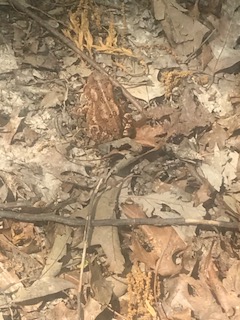
So all this to say that I would have missed several encounters with the wild if I hadn’t stopped a time or two, but I was just getting started on my walk. (I have a great video of some minnows in a creek, too, that I wish I could upload here.) Still with no certain destination, I didn’t feel the need to hurry, though. I would just continue to stroll until I hit a place to stop for a snack after about 2 1/2 miles and then head back to where I started. At least that was the plan until I saw this sign.
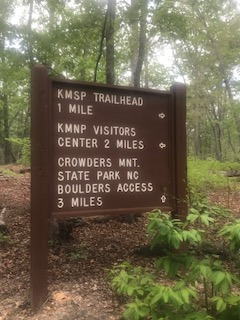
KMNP Visitors Center, 2 miles. The Visitors Center would have a clean bathroom to use plus a safe place to sit and write for a while and enjoy my sunflower seeds. That is what I would do – hike from the State Park to the National Park and back again for a round trip of about 6 miles. Perfect. I could be at the Visitors Center from my starting point in about an hour, maybe longer since I had already stopped some to enjoy the surroundings. I now had a set destination and had calculated an estimated time of arrival. I was now on a quest.
A quest. How had I found myself on a quest once again? My life seems like a never-ending quest every day, or more like a thousand tiny quests every day. A quest to eat more protein and avoid processed foods; a quest to look younger, more attractive, and stylish; a quest to be a better wife and mom; a quest for better test scores for my students; a quest to find time to read something that interests me; a quest to stay on top of breaking news so I can be an informed citizen; a quest to write something meaningful, or to write something at least regularly, for both professional and personal purposes; a quest to help my sons succeed; a quest to be a sympathetic, understanding, and helpful leader for my department at work; a quest to work out and grow stronger; a quest to strengthen my spiritual connection to God; a quest to love others as the Bible instructs me to do; a quest to have clean towels and an empty kitchen sink. I came to the woods to ditch the quest mentality, to find tranquility, to reset my brain, and here I was, back on a quest of my own making, battling the clock, dead set on hitting the next check point.
In fact, just this week, my AP students and I had been reading Emerson’s “Nature,” learning about the Transcendental Moment. Emerson speaks of “the integrity of impression made by manifold natural objects,” the ability to soak in all that Nature has to teach me. He says, “There is a property in the horizon which no man has but he whose eye can integrate all the parts.” I have always wanted to be that poet Emerson describes here, the one who still retains “the spirit of infancy even into the era of [wo]manhood,” who can leave behind her life in the civilized world and sit still for a moment in the woods and learn what Nature may have to teach her in those few moments we have alone together. I had just told my students that I needed regular visits to the trails for exactly the reason Emerson describes – a chance to reset my priorities, examine what really matters, allow God to speak to me in the wind and through the creek ripples. I told them of my plans to hit the trail this weekend because May for a teacher is a terribly busy time, one filled with testing and deadlines and expectations. I needed a moment where “all mean egotism vanishes,” where I become “part or particle of God,” where I can forget myself for just a minute and thereby find myself again.
Yet, a mile into my walk, and I had already set a goal and was on my quest. Even as my feet picked up speed, I found myself thinking exactly what Marc would have said to me had he been there: “Slow down. Why are you always thinking about what comes next? I thought you wanted to have a moment of quiet, away from the world.” I knew his voice in my head was right, as it always is. Even at home, he admonishes me to take a break, sit still and enjoy our time together, rest a minute, embrace the moment. “You don’t always have to be doing something, Kristie,” he would say.
I needed Marc on the trail with me. As proud as I was of my determination to hike alone and navigate the roots by myself, I needed him there to remind me why I was there. Even though I never fell down all the times I tripped over roots and rocks, I missed having him there to look out for me. The entire time I walked, I took photos, all with the intention of showing them to Marc when we met back together at home that evening. I was quite close to talking to myself as I walked, all the time forming my thoughts for how I was going to tell him about the snake, and the frogs, and even the minnows in the creek.
Emerson later says, “The greatest delight which the fields and woods minister, is the suggestion of an occult relation between man and the vegetable.” I agree, yet, I have to expand on what he says. That occult relation occurs between me, Nature, God, and Marc. I find solace and refreshment in the woods because I find connection in the woods – connection to God, of course, but also to Marc. The three of us are intertwined, you know, since the “two shall become one” and all. And as I formed my thoughts about all I wanted to tell Marc about my hike, I started thinking about Marc and me and just how intertwined we really are. In some ways, my life has little meaning except as I see it through his eyes. Whatever happens to me on any given day doesn’t really exist until I tell Marc about it when I get home. Of course, I know that I am an individual with a life of her own, but it is only when I tell him about those events that occurred when I was alone that I feel like those events meant something. For most of our adventures, we travel together, and through those adventures, our shared experiences deepen our relationship and create memories that shape who we are as Marc and Kristie. Yet, when we are not together, I continually take mental notes on just what all I need to tell Marc when we are together again. And I needed him in the woods to watch out for roots for me and remind me to slow down, but also to see the minnows and hear the lizards and take the photo of the frog with me. I couldn’t help but think about that snake again because Marc would have hated the snake and probably wouldn’t have even wanted me to take the photo, but I would have while he urged me to back up. And I will tell this story tomorrow when we read “Serpents of Paradise” in class, and when Ed Abbey describes his relationship to the gopher snakes, I will think about my relationship to Marc: “Sympathy, mutual aid, symbiosis, continuity.”
So, once again, Emerson was right, but then again, he wasn’t. Emerson says that in the Transcendental Moment, “the name of the nearest friend sounds then foreign and accidental: to be brothers, to be acquaintances,—master or servant, is then a trifle and a disturbance.” Maybe I haven’t truly experienced the Transcendental Moment, but I don’t want to experience it without Marc there with me. The rest of the world can feel foreign and accidental within the Transcendental Moment, but without Marc, the world is foreign and accidental all the time. And I know that as I experience life with Marc, in those trifling moments of folding laundry or taking our car to the mechanic or trimming the bushes – it is in those moments that I am truly “the lover of uncontained and immortal beauty.”
 Kristie Camp